Published:
16 May 2016
Category: Practical Guides
Shopping Cart
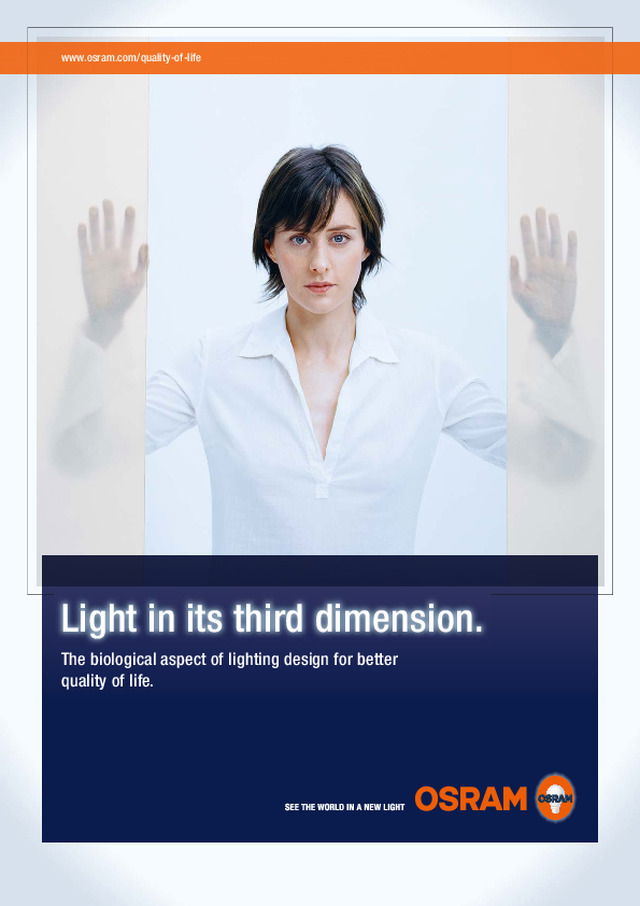

Light in its Third Dimension.
Up to now, the principal function of artifi cial light was to assist our visual perception. Recent studies have shown however that there is another dimension. Light drives our internal clock and therefore has a considerable effect on our well-being.
www.osram.com/quality-of-life Light in its third dimension. The biological aspect of lighting design for betterquality of life.
2 The discovery of human well-being. Up to now, the principal function of artifi cial light was to assist our visual perception.Knowledge gained through scientifi c research and embodied in standards and laws has provided architects and engineers with a basis for planning lighting systems. Recent studies have shown however that there is another dimension. Light drives our internal clock and therefore has a considerable effect on our well-being. The white light from the new OSRAM SKYWHITE ® lamp has an activating effect, boosting concentration at the workplace and improving quality of life as part of a coordinated lighting concept. The three dimensions of light.The 1 st dimension: The theory of optimum vision with the aid of artifi cial light sources; a corpus of legislation and standards on the basis of scientifi c fi ndings.The 2 nd dimension: Implementation of this theory in the design and construction of lighting sys- tems that improve human perception.The 3 rd dimension: Research into the biological effects of light and the application of these effects for improved well-being, greater powers of concentration and better quality of life overall. THE 3 RD DIMENSION OF LIGHTING DESIGN
3 THE 3 RD DIMENSION OF LIGHTING DESIGN
4 SCIENTIFIC FINDINGS We control light. But light also controls us. We need good quality light in order to see well. But light has a much more far-reaching signifi cance. Without our being aware of it, light controls biological processes in our bodies and therefore our inter-nal clock. Light also dictates whether we are active or tired, whether we can concentrate or not and whether we feel good or not. In buildings however we mostly lack suffi cient light and in particular the right light to stimulate our bodies. At work, we are often in biological darkness.
06:00 Cortisol level 12:00 18:00 24:00 06:00 12:00 18:00 24:00 06:00 Melatonin level ~30° bisweniger 4g 90° nich(Blen 5 SCIENTIFIC FINDINGS Light controls our internal clock. Biorhythms dictate when we wake up, when we become tired and when we fall asleep; they even have an effect on our body temperature and much more. The control center for our internal clock is in our brain and is heavily infl uenced by light. Although our “circadian rhythm” is basically determined by our genetic makeup, our internal clock has to be resyn- chron ized by daylight each and every day. Without light as the prime regulator our internal clock soon goes out of sync. As a result we may suffer from sleep disorders, chronic fatigue and in the worst case clinical depression. Light acts on the control center in the brain through a third photoreceptor which was discovered only a few years ago. The effect of light of natural daylight quality with a high blue component is much stronger than light from an incandescent lamp for example with its high red component. The effect is greatest when light comes from a light source with a large surface area. Indirect lighting in which light is re- fl ected from a large bright surface such as a white wall there- fore has a stronger impact than the concentrated light from a spotlight that illuminates only a small area. This is because the photoreceptors in the eye are distributed very evenly over the retina. The signal to the control center in the brain – and therefore the biological effect – is greatest when as many photoreceptors as possible are stimulated si- multaneously. Such a full-scale impact on the retina can only come from a correspondingly large area in our fi eld of vision. Light affects our body: Daylight with a high blue component has an activating effect and boosts concentration because it stimulates the receptors in the eye and therefore the control center in the brain to a much great- er extent than light with a high red component. Biological effect of light on the human eye: The activating effect of light depends not only on the light color but also on the size of the light source (indirect lighting) and the correct angle of incidence of the light beam in the eye. For detailed information see our glossary on page 22. Further reading on page 23. Circadian rhythm, hormone secretion:There are basically two hormones in humans that are responsible for the circadian rhythm : melatonin, which is released in response to increasing levels of darkness and which promotes sleep, and cortisol, which is the biological opposite of melatonin and an indicator of the level of human activeness. 0° to ~30°No effect ~30° to ~45°Unsatisfactory 45° to ~90°Good [a cv optimum] 90° to 180°Not desirable(risk of glare)
6 IMPACT ON LIGHTING DESIGN Human nature – and innovative room lighting. Up to now, people have had to live with whatever artifi cial light was provided at their plac-es of work and simply get used to it. From a biological point of view, indoor lighting has never been ideal. This is because we humans have adapted over millennia to the rhythm of natural daylight with its progressive illuminance and variable color temperature. OSRAM has now taken this into account – with components that really meet the needs of human beings.
~30° bisweniger 4g 90° nicht(Blen 7 IMPACT ON LIGHTING DESIGN Lighting management systems in combination with biolo- gically effective light can convincingly simulate daylight in its natural progression through the day and perfectly adjust artifi cial room lighting according to the amount of available sunlight. 1 The vertical luminance is particularly important for biolo- gically active light. Standard lighting concepts have a de- creasing amount of vertical luminance and this should be compensated by additional luminaires to achieve a posi- tive biological effect. 2 New luminaire design for wallwashers and ceiling washers with 2-way systems ensure that the light falls precisely where it has the optimum biological impact, with surfaces in the room acting as large refl ectors. 3 Ceilings and walls symbolize our external world and pro- vide biologically effective light stimuli. This can be con- sciously enhanced with indirect lighting. 4 Daylight provides the reference. The illuminance and color temperature are based on mother nature. A positive biological effect can be achieved by wide-area lighting in the upper fi eld of view. This corresponds to the sky in our natural envi-ronment. Illuminated surfaces in the room such as walls can be used to very good effect. Wall and ceiling colors should also refl ect blue components in the light however. The focus shifts to the design of the luminaire particularly if there are no surfaces with adequate refl ective properties that can be used. Such lumi-naires integrate several lamps and vertical surface elements. They therefore enable the light color to be controlled and provide wide-area lighting for the eye. As you can see, this can be combined with attractive styling. 0° to ~30°No effect ~30° to ~45°Unsatisfactory 45° to ~90°Good [a cv optimum] 90° to 180°Not desirable(risk of glare)
8 BENEFITS FOR PROPERTY DEVELOPERS As bright as day – and extremely effi cient.
9 BENEFITS FOR PROPERTY DEVELOPERS Hand in hand with daylight: EASY Color Control. Daylight boosts human activity and promotes a feeling of well-being. In most cases the daylight entering a room through a window is not enough for people working in that room. For most of the working day that light has to be supplemented by artifi cial lighting. But because the light changes over the course of the day it has always been diffi cult to adjust the room lighting to take account of these changes. With the EASY Color Control system OS- RAM offers a solution that meets all the requirements. EASY Color Control manages the lighting system in such a way that the intensity of the light, its color temperature and the dynamics of the indoor lighting system ideally supple- ments natural daylight at all times during the day. The lamps are controlled in such a gradual way that the changes are imperceptible and therefore unobtrusive. The results however are very noticeable indeed. There are increases in the perform - ance, motivation and effi ciency of employees – and energy consumption for the lighting system is reduced. For more in- formation go to: www.osram.com/ecg-easycolorcontrol Paul von Rickenbach, owner of the Muotathal furniture factory in Switzerland:“We made the change to OSRAM fl uorescent lamps. The SKYWHITE ® light color of 8000 K is the perfect supplement to natural daylight. After just two days of getting used to the new lighting system none of our employees wanted to do without this cool blue light. And our employees have reported that they feel less tired, have fewer headaches and can concentrate much better.” University of Madrid, con-ference room with dynamic daylight si-mulation
10 EXPERIENCE AT THE WORKPLACE A noticeable improvement in perfor- mance.
11 EXPERIENCE AT THE WORKPLACE Hard work and concentration by day, rest and relaxation at night. Light similar to natural daylight is not just brighter, it stabilizes the circadian cycle, helping us to be active during the day and sleep better during the night. The control center for our internal clock is more receptive to light with a pronounced blue component, so this light makes us more alert, more attentive and more able to concentrate on our work during the day. And our recovery during the night does not suffer as a result – quite the opposite. Biologically effective light during the day increases secretions of the melatonin hor- mone during the night. Melatonin is the body’s own signal for darkness and pro- motes sleep. The consequences are obvious – more restful nights as the body needs less time to get to sleep and goes into deeper sleep. People who get a good night’s sleep are capable of better performance at work during the day. Artifi cial daylight (spectrum and dynamics) at the workplace therefore has a two- fold positive effect on performance and well-being. Modern light – developed on the basis of recent scientifi c fi ndings – can make work more pleasurable and more successful. Which in turn makes employees feel better about themselves. Walter Hueck, Technical Service, OSRAM GmbH:“We recently had this new lighting installed. I used to get the impression that some of the areas where I work were pretty dark. Now that has all changed. After a short period of getting used to the new lighting everything looks much nicer and more spacious than before. I am also more alert, can concentrate better and feel happier in this light. Work is much more fun with this lighting. And of course good lighting means that the risk of accidents is much smaller.”
12 THE MEDICAL VIEW Activity, concentration and cheerfulness instead of lethargy, fatigue and gloom.
13 THE MEDICAL VIEW The natural day/night cycle caused by the Earth’s rotation is an impor- tant factor in the regulation of biological processes in the human body. The natural progression of daylight plays a crucial role in synchronizing these processes. The more precisely our internal clock is in synchronism with this day/night cycle the more capable we are of working well during the day and sleeping well at night. This has a positive effect on our moods and well-being and therefore on our general behavior. More blue in the light. In places where we lack adequate natural light it makes sense from the medical point of view to simulate daylight with the aid of artifi cial lighting. At workplaces in particular the addition of blue light with a wavelength around 460 nm can help because light with a high blue component has an activating effect on humans and boosts concentra- tion. Regular and coordinated. The time factor also has a considerable infl uence on the effect of light. This is because our internal clock has a “memory”. For this reason, the infl uence of light should not only be regular but should also be co- ordinated with other timers (also known by the German name of zeitge- ber) such as activity and food intake. Prof. Dr. Jürgen Staedt, Medical Director at the Klinik für Psychiatrie, Psychotherapie und Psy-chosomatik – Memory Clinic Vivantes-Klinikum Berlin-Spandau:“A daily dose of bright light with a suffi ciently high blue component is extremely ad-visable, particularly in the dark winter months, for sta-biliz ing our day/night cycle and therefore for our general well-being. In gen eral medi-cine we are now using light more and more to achieve improvements in the general moods of our patients.”
14 NEW OPPORTUNITIES FOR LIGHTING DESIGNERS Professional planning right from the start brings the best results. To implement a lighting concept with biologically active light and high energy effi ciency, lighting designers need to be integrated into the building project at as early a stage as possible. This is because the geographical location of the building, its compass orientation, its window sizes and its shading by other buildings are all important criteria for successful planning with daylight-dependent lighting systems. 3000 K 4000 K In the morning In the evening
15 NEW OPPORTUNITIES FOR LIGHTING DESIGNERS The basic principles of a biological lighting concept. Ceilings and walls with surfaces that are as bright as possible can be used as large secondary refl ec- tors to access the relevant photoreceptors in the human eye to maximum effect. The luminances of the surfaces in a room must not exceed the permitted values however, otherwise there may be undesirable direct and refl ex glare. The luminaire industry provides valuable support here. A wide variety of different luminaires are available on the market that either provide indirect light off wall and ceiling surfaces or, as pendant versions, have large refl ecting surfaces themselves. An appropriate control system such as EASY Color Control in conjunction with QTi DALI ® ECGs, can dynamically change the color temperature of the light to simulate the changes in natural daylight. This requires the luminaire to be equipped with at least two different light colors, preferably LUMILUX SKYWHITE ® 880 and Warm White 830, and a cover of specially selected dispersion material (see glossary, pp 22–23). The lighting system can be switched on either with a standard light switch or by a motion sensor. 6500 K 8000 K Midday
16 NEW OPPORTUNITIES FOR LIGHTING DESIGNERS Every room presents its own challenges. The rooms in which we live, work, learn or relax are all very different. Professional lighting design takes into account the size of the room, the ceiling height, the amount of daylight entering the room and obviously the main activities that will be carried out in the room. Suitable luminaires are selected and arranged according to these criteria. Lighting design based on biological aspects therefore makes special demands on the luminaires and the distribution of light in the room. 4 2
17 NEW OPPORTUNITIES FOR LIGHTING DESIGNERS Luminaires tailored for every room. In standard rooms, luminaires integrated in the ceiling parallel to the walls can illuminate the wall surfaces. 1 Plasterboard facings with integrated indirect light- ing serve the same purpose. 2 In very large rooms with relatively low ceilings the wall surfaces are not as important – the ceiling should act as the refl ective surface here. “Light ceil- ings” made of translucent materials and backlit with SKYWHITE ® 880 offer excellent results here. 3 If light ceilings are not possible, luminaires with a strong element of indirect light can be used to il- luminate the ceiling with biologically effective light. 4 Pendant luminaires with large refl ecting surfaces in which the light is visible help in factories and large enclosed spaces with high ceilings. 5 5 4 2 1 3 1 4 3
18 DYNAMIC LIGHTING SOLUTIONS Light as a partner. A biologically effective lighting system provides ideal support for working people by offering artifi -cial light that dynamically following the changing light patterns of the day without having to be man-ually controlled. The brightness and light color of this artifi cial light change slowly over time, sup-plementing the available daylight without any irri-tating effects. Employees barely notice these changes but do register the dynamics in the best possible way, namely indirectly. They benefi t from light that meets their needs perfectly and at all times – and they feel good and active. Biologically effective light is a constant visible but unobtrusive partner in all indoor activities. A unifi ed approach. Dynamic lighting concepts for modern buildings call for perfectly matched technical components. There must be no compromises at the various in- terfaces. All the devices must be able to commu- nicate with one another without restriction and re- act accordingly. A common interface for all the components within a system is of enormous im- portance if the lighting control system, sensors, controllers, electronic control gear and lamps are to communicate effectively with one another. The DALI ® interface – the ideal platform. DALI ® stands for Digital Addressable Lighting In- terface and provides the basis for unrestricted da- ta communication within a lighting system. QTi DALI ® electronic control gear is particularly suitable for optimum daylight simulation. Its digital interface translates the dimming values precisely into the required mixing ratios. In addition, intelligent control of electrode preheating in dimming opera- tions ensures that the lamps achieve their maxi- mum life.
Group A Group B AB 19 EASY Color Control configu-ration software EASY Color Control for superior daylight simulation. EASY Color Control is the perfect system for simulating changes in natural daylight throughout the day. It provides very slow transitions that are virtually imperceptible to the eye. For more information go to: www.osram.com/ecg-easycolorcontrol DALI ® MULTI 3 – the natural partner for daylight. The DALI ® MULTI 3 lighting management system is recommended if the lighting system is to be control- led on the basis of the amount of available daylight. Its 50 mm mini ceiling sensor for light and movement can be easily and unobtrusively integra- ted in any room architec ture. For more information go to: www.osram.com/lms-dalimulti3 DYNAMIC LIGHTING SOLUTIONS Up to 16 DALI ® EASY II or OT EASY 60 units in a system area Up to 8 pushbutton or switch inputs per EASY switch coupler Presence sensors EASY remote control EASY infrared receiver Up to two EASY pushbutton couplers USB connection DALI ® EASY II QTi DALI ® 2700 K 8000 K White 60 W LED modules OT EASY 60 2700 K 6700 K Touch Panel Y connector System coupler for EA-SY system area Can be expanded to as many as 64 OT EASY 60 or DALI ® EASY II units via 3 system couplers
20 TECHNOLOGY A complete system from a single source. A functional lighting solution comprises a variety of com-ponents. For effi cient trouble-free operation the lamps and electronic control gear have to work perfectly with the lighting control system. OSRAM offers specially matched systems from a single source for various areas of appli-cation.
21 TECHNOLOGY QUICKTRONIC ® INTELLIGENT ECGs and LUMILUX ® fl uorescent lamps. LUMILUX SKYWHITE ® fl uorescent lamps from OSRAM with their high blue component (8000 K) are the perfect solution for lighting systems with daylight-dependent control. In com bination with LUMILUX ® Warm White (2700 K) they can simulate the light color of natural daylight. QTi DALI ® ECGs with their superior dimming technology are recom- mended as the electronic control gear. For more information go to: www.osram.com/ecg White LED modules and OT EASY 60 units. White LED modules are available in different designs and color temperatures from 2700 K to 6700 K. The various OP- TOTRONIC ® units are perfectly matched to OSRAM LED modules to ensure durable trouble-free operation. The OT EASY 60 unit is ideal for dynamic daylight simulation with white LED modules. For more information go to: www.osram.com/ecg and www.osram.com/led Effi cient and eco-friendly. Daylight-dependent lighting systems from OSRAM are extremely effi cient. Fluorescent and compact fl uorescent lamps and LEDs from OSRAM are some of the most economical and durable light sources available. In conjunction with the appropriate electronic control gear their effi ciency and longevity are further improved. By using available daylight and the presence of a person or persons in the room as control elements (in conjunction with DALI ® MULTI 3) it is possible for the lamps to burn only for as long and as brightly as is absolutely necessary. As a result, operating costs are signifi cantly reduced. This also represents an enormous relief for the environment. Resources are protected and CO 2 emis- sions are reduced. For more tips and advice for your lighting solutions go to: www.osram.com/global-care and www.osram.com/light-consultant Intelligent lamp detection 54 W 28 W
22 FURTHER INFORMATION Glossary. Action spectrumThis is the spectral sensitivity for an effect triggered by light. There are action spec-trums for a wide variety of biological effects, for example for the occurrence of sunburn due to UV or for the formation of vitamin D due to UV-B. The action spectrum for the sensitivity of the eye is the v( λ) curve. The c( λ) function proposed by Professor Gall cor-responds to the action spectrum for night-time melatonin suppression by light. It is now assumed that the other biological effects of light essentially follow this action spectrum. Circadian rhythmA biological cycle with a period of approximately 24 hours (from the Latin circa = about, dies = day). Circadian rhythms can be found in almost all life forms – animals and plants. Not only the essential functions of the entire organism but almost every indi-vidual organ and even every individual cell have their own genetically predefi ned circa-dian rhythm. The interplay of these individual cells and organs produces the out wardly visible or measurable circadian rhythms for the entire organism. Light is the most important “zeitgeber” for the circadian rhythm. It is the effect of light that synchro-nizes the rhythm to the 24 hours of a day. Third photoreceptorThese are sensory cells in the human eye that transmit information about the bright-ness of the surroundings via the SCN (suprachiasmatic nucleus) to the pineal gland and thereby infl uence the production and secretion of the hormone melatonin. Studies by Brainard have shown that these cells are sensitive to light at the blue end of the spectrum (Brainard 2001). In 2002 Berson identifi ed the ganglion cells containing melanopsin in the retina as the cells responsible (Berson 2002). In addition to their function in processing stimuli for visual signals they have their own (intrinsic) sensitivity to light. The light sensitivity of the retinal ganglion cells is approximately factor 100 less than that of the cones responsible for color vision. Ganglion cellsThese are nerve cells that are responsible for processing and transmitting nerve impuls-es from receptor cells. With regard to the biological effect of light the retinal ganglion cells are of particular importance. For a long time it was assumed that these ganglion cells were responsible only for processing information from the visual recept ors – the cones and the rods. Ganglion cells for example take the mix of signals from red and green-sensitive cones and produce a signal for yellow that is transmitted to the brain. It is this ability to mix signals that enables us to perceive all the different colors. Around 2 to 3 % of these ganglion cells are themselves sensitive to blue light. They act as “third photoreceptors”. Field of viewThis is the extent of the observable world that lies before our eyes and can be formed on the retina without moving our eyes. The fi eld of view of an eye is limited by the size and optical properties of the components of the eye (cornea, lens, iris, vitreous body) and the population of the retina with visual cells (cones and rods). The fi elds of view of our two eyes overlap signifi cantly. Internal clock Also known as the biological or physiological clock. The internal clock is the central ele-ment of the timing system. Its progress is genetically predetermined but is essentially con-trolled by the SCN and therefore infl uenced signifi cantly by light. Light is consequently the most important “zeitgeber” for the internal clock; it synchronizes the internal clock with the external day. The status of the internal clock, in other words the phase of the biolog-ical clock, is the sum of overlaying all the body’s circadian rhythms. The phase can be largely deduced from the melatonin level curve. MelanopsinThis is a photopigment that is responsible for the light sensitivity of the retinal ganglion cells. Its sensitivity can be described by the action spectrum for melatonin suppression, with a maximum at around 464 nm – in other words at the blue end of the spectrum. Through the absorption of light, melanopsin transmits the nerve signals that lead to the suppression of melatonin. Opsin is the general term for a light-sensitive pigment (photo-pigment) in the eye. The pigment undergoes a change when it absorbs photons (quan-tums of light), releasing a chemical signal chain at the end of which is a conversion to electrical signals in the nervous system. The pigment in the rods for light/dark vision is rhodopsin; the pigments in the cones are iodopsin, porphyrosin and cyanopsin. Melatonin (suppression)Melatonin is the most important hormone of the pineal gland and can be described as the body’s signal for the nightly dark phase. It promotes sleep in humans and activity in nocturnal animals. Melatonin is produced and stored continuously in the pineal gland from serotonin, and is released only in the dark. Light causes secretion of melatonin to be suppressed. If no melatonin is released the level of melatonin in the bloodstream falls as a result of decomposition processes. As melatonin is the most important measur-able marker for the circadian phase of the internal clock the melatonin-suppressing ef-fect is generally equivalent to the circadian effect, i.e. the biological effect of light on the internal clock. RetinaThis is the layer of cells on the back wall of the eye that contains the visual cells and the information-processing nerve cells, including ganglion cells. Photoreceptors These are light-sensitive sensory cells that convert quantums of light (photons) into the electrical signals for the nervous system. The photoreceptors in the retina of the human eye are called cones, rods and melanopsin-carrying ganglion cells. The cones are re-spon sible for color vision. They are at their greatest density in the center of the eye, known as the macula lutea or yellow spot. This is the area of the retina that provides the greatest spatial resolution. The rods are responsible for light/dark vision and have a greater sensitivity than cones. They are therefore important for night vision. They are mainly found at the periphery of the fi eld of view. The melanopsin-carrying ganglion cells are not considered to be visual cells as they do not transmit images to the central nervous system but merely provide brightness information for controlling the internal clock. SCNSuprachiasmatic nucleus: a collection of several thousand nerve cells situated above (supra) the intersection of visual nerves (chiasma). Now considered as the main regula-tor of the internal clock. Each of the nerve cells in the SCN has its own internal clock. Normally the internal clocks of these cells are in synchronism and therefore amplify the “zeitgeber” signal to form a common strong control signal for the internal clock. Info pool.
23 FURTHER INFORMATION Dispersion material propertiesProperties of translucent materials for scattering the light shining through them. c( ) V( ) 10,90,80,70,60,50,40,30,20,10 380 420 460 500 540 580 620 660 700 740 780 Circadian sensitivity – humans [nm] Visual eye sensitivity – humans 10,90,80,70,60,50,40,30,20,10 c( ) V( ) 380 420 460 500 540 580 620 660 700 740 780 Circadian sensitivity – humans [nm] Visual eye sensitivity – humansFilter absorption Graphic on left: Spectrum of a fl uorescent lamp, light color 880, a cv = 1; Φ = 4000 lm at 25° (54 W). Graphic on right: Change in the spectrum with reduced spectral transmission at the blue end of the spectrum through fi lters such as plastic materials. The example of a change in light due to the fi lter characteristics of dispersion plates is generally valid – irrespective of the type of light source. In actual practice it has an effect principally if the light has a high blue component. The lack of short-wave blue components tends to be inconspicuous and can often only be detected through precise measurements across the entire spectrum. Particular attention must be paid to the ag-ing of plastics under the infl uence of high temperatures or UV radiation because even slight yellowing can lead to a signifi cant fi lter effect and therefore to reduced biological effectiveness. A comparable effect with indirect lighting can weaken the biological im-pact if the wall material or color does not refl ect blue light well. Seasonal affective disorder (SAD)Also known as winter depression. Many people suffer mood changes during the winter months which may even be serious enough to qualify as clinical depression. Triggering factors for SAD are generally given as short daylight hours and low light levels during the “dark season”. Other (endogenous) factors must also be considered as the causes of winter depressions. Phototherapy with very bright light helps in many cases. Suffi -ciently bright light during the day can also prevent the onset. Zeitgeber“Zeitgeber” is the German word for timer. It is used to denote any factor that may set the internal clock. The most important zeitgeber is light, which acts on the SCN through the eye via the retinohypothalamic tract. In the SCN is the central internal clock that controls a large number of circadian rhythms. Other zeitgebers are in the liver for example and these too control circadian rhythms. Pineal glandThe pineal gland is also known as the pineal body, corpus pineale or epiphysis. The pin-eal gland sits in the center of the brain and is a protuberance of the diencephalons or interbrain. The main product of the pineal gland is the hormone melatonin which is secreted into the bloodstream during the dark hours. Literature. Berson, D. M. et al.: Phototransduction by retinal ganglion cells that set the circadian clock. Science 2002, 295: 1070. Boyce, P. R. et al.: Lighting quality and offi ce work: two fi eld simulation experiments. Lighting Res Techn 2006, 38(3): 191–233. Boyce, P. R.: Education: the key to the future of lighting practice. Lighting Res Techn 2006, 38(4): 283–294. Brainard, D.H. & Maloney, L.T.: Perception of color and material properties in complex scenes. J Vis 2004, 4(9): ii-iv. Brainard, G. C. et al: Action spectrum for melatonin regulation in humans: evidence for a novel circadian photoreceptor. J Neurosci 2001, 21(16): 6405–6412. Brainard, G.C. et al.: Human melatonin regulation is not mediated by the three cone photopic visual system. J Clin Endocrinol Metab 2001, 86(1): 433-436. Cajochen, C. et al.: High sensitivity of human melatonin, alertness, thermoregulation, and heart rate to short wavelength light. J Clin Endocrinol Metab 2005, 90(3): 1311-1316. Figueiro, M.G., et al.: Circadian effectiveness of two polychromatic lights in suppressing human nocturnal melatonin. Neurosci Lett 2006, 406(3): 293-297. Gall, D.: Die Messung Circadianer Strahlungsgrößen, 2004, http://www.tu-Ilmenau.de/fakmb/fi leadmin/template/fglt/publikationen/2004/Vortrag_Gall2004.pdf Gall, D., Lapuente, V.: Beleuchtungsrelevante Aspekte bei der Auswahl eines förderlichen Lampenspektrums. Licht 54 (2002) 7/8: 860–871. Glickman, G. et al.: Inferior retinal light exposure is more effective than superior retinal exposure in suppressing melatonin in humans. J Biol Rhythms 2003, 18(1): 71–79. Hanifi n, J.P. & Brainard, G.C.: Photoreception for circadian, neuroendocrine, and neurobehavioral regulation. J Physiol Anthropol 2007, 26(2): 87–94. Kline, C.E. et al: Circadian variation in swim performance. J Appl Physiol. 2007 102(2): 641-649. Leproult, R. et al.: Transition from dim to bright light in the morning induces an immediate elevation of cortisol levels.J Clin Endocrinol Metab 2001, 86(1): 151-157. Lockley, S.W. et al.: High sensitivity of the human circadian melatonin rhythm to resetting by short wavelength light. J Clin Endocrinol Metab 2003, 88(9): 4502-4505. Lockley, S.W. et al.: Short-wavelength sensitivity for the direct effects of light on alertness, vigilance, and the waking electroencephalogram in humans. Sleep 2006, 29(2): 161-168. Mills, P.R. et al.: The effect of high correlated colour temperature offi ce lighting on employee wellbeing and work performance. J Circadian Rhythms 2007, 5: 2. Morita, T. & Tokura, H.: The infl uence of different wavelengths of light on human biological rhythms. Appl Human Sci 1998 17(3): 91-96. Panda, S. et al.: Melanopsin (Opn4) requirement for normal light-induced circadian phase shifting. Science 2002, 298(5601): 2213-2216. Rea, M.S.: Light – Much more than vision (Keynote). Light and Human Health: EPRI/LRO 5 th International Lighting Research Symposium: Palo Alto, CA: The Lighting Research Offi ce of the Electric Power Research Institute (2002): p.1–15. Rea, M.S. et al.: A model of phototransduction by the human circadian system. Brain Res Brain Res Rev 2005, 50(2):213-28. Erratum in: Brain Res Brain Res Rev. 2007, 56(1): 270. Revell, V. L. & Eastman, C. I.: How to trick mother nature into letting you fl y around or stay up all night. J Biol Rhythms 2005, 20: 353–365. Rüger, M. et al.: Nasal versus temporal illumination of the human retina: effects on core body temperature, melatonin, and circadian phase. J Biol Rhythms 2005, 20(1): 60–70. Schierz, C.: Leben wir in der „biologischen Dunkelheit“. Licht 2002; Maastricht Sept. 2002; Proceedings: 381–389. Takasu, N.N. et al.: Repeated exposures to daytime bright light increase nocturnal melatonin rise and maintain circadian phase in young subjects under fi xed sleep schedule. Am J Physiol Regul Integr Comp Physiol. 2006, 291(6): R1799–1807. Thapan, K., Arendt, J., & Skene, D. J.: An action spectrum for melatonin suppression. Evidence for a novel non-rod, non-cone photoreceptor system in humans. J Physiol 2001, 535(1)261. Van Cauter, E. et al.: Rapid phase advance of the 24-h melatonin profi le in response to afternoon dark exposure. Am J Physiol. 1998, 275(1 Pt 1): E48–54. Vandewalle, G. et al.: Brain responses to violet, blue, and green monochromatic light exposures in humans: prominent role of blue light and the brainstem. PLoS ONE. 2007, 2(11): e1247. Zaidi, F.H. et al.: Short-wavelength light sensitivity of circadian, pupillary, and visual awareness in humans lacking an outer retina. Curr Biol 2007, 17(24): 2122-2128.
199W011GB OSRAM CRM CC 09/08 PD Subject to modifica tion without n otice. Errors and omissions excepted. z Printed on pa per trea ted with chlorine-free blea ch. OSRAM GmbH Head Offi ceHellabrunner Strasse 181543 MunichGermanyFon +49 (0) 89-6213-0Fax +49 (0) 89-6213-20 20www.osram.dewww.osram.com www.osram.com/quality-of-life Further information: On the redesigned OSRAM website you can fi nd more than just the fascinating world of light and lighting, the latest information and interesting links, you can also download various practical tools and service offerings for lighting designers and architects. See the world in a new light – www.osram.com We would be pleased to answer any questions you may have about planning and implementing daylight-dependent lighting systems. Please contact: Hans-Jürgen Froböse [email protected] Fon: +49(0)89 678 45-160 Kunz von Kriegelstein [email protected] Fon: +49(0)89 6213-2715 Dieter Lang [email protected] Fon: +49(0)89 6213-3321 Always there for you! The DIALux 4.5 program from the Deutsches Institut für angewandte Lichttechnik (German Institute for Applied Lighting) is an excellent intuitive design tool for professional lighting design. This software is available free of charge. It supports all the major languages of the world and takes into account the latest legislation and planning standards for the particular country. The program enables you to analyze and visualize lighting projects quickly and easily. DIALux is available from: www.dial.de Plan with DIALux – fast, accu-rate and clear.